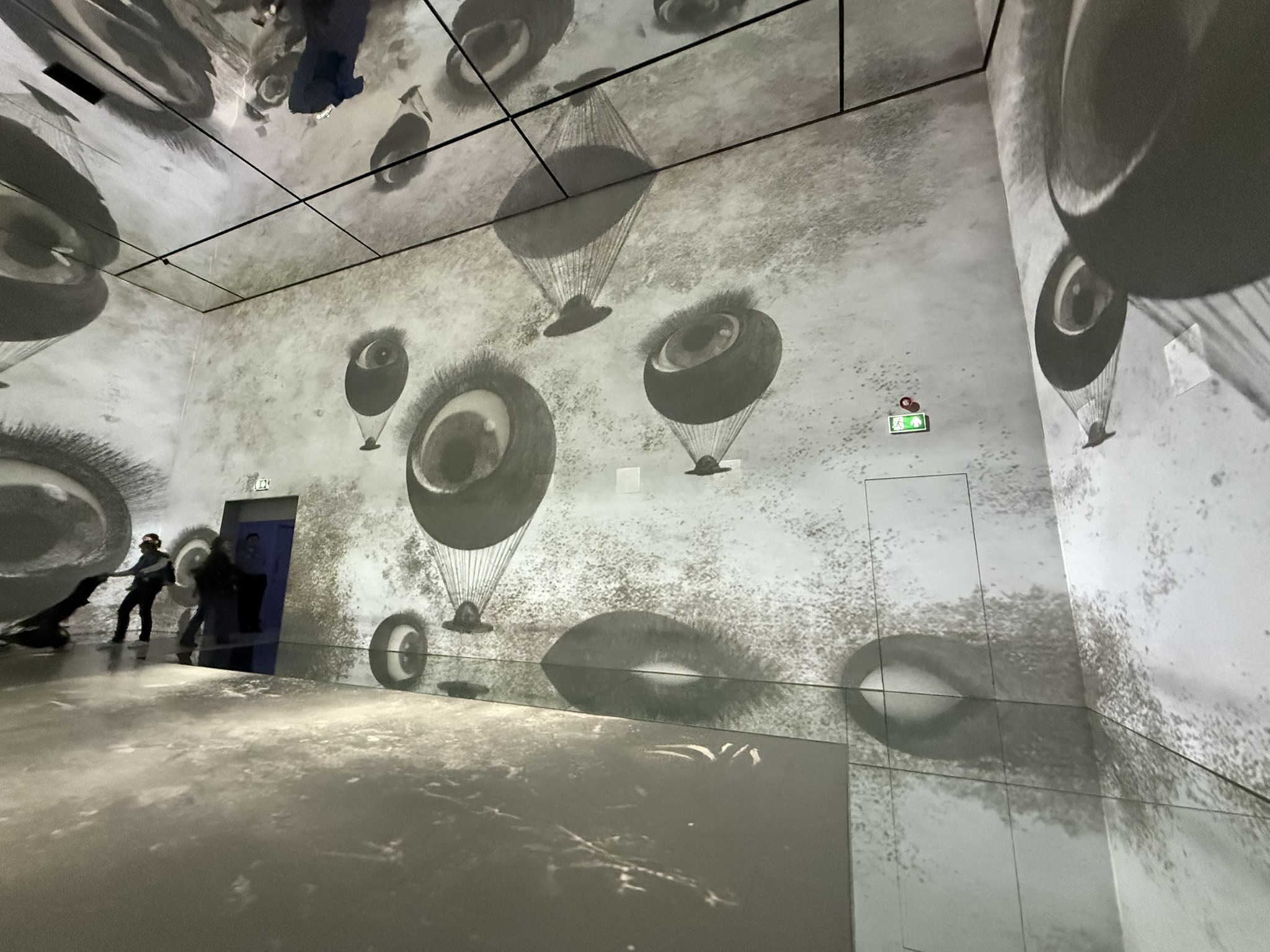
Frameless in London describes itself as a space that “showcases some of the world’s greatest works of art presented in ways never seen before. Where art breaks free.” Visitors step inside four immersive galleries featuring reimagined works by artists such as Monet, Kandinsky, Dalí, Van Gogh, Rembrandt and Klimt. The paintings are projected at architectural scale. Elements are animated. Rooms scroll. Soundtracks accompany shifting compositions. The viewer does not stand before the canvas; the canvas engulfs the viewer.
The experience is compelling. But it also raises questions that sit directly into my research on authorship and collaboration.
1. Authorship and the Question of Collaboration
At Frameless paintings are scaled to room size and animated. Clouds drift beyond their original position. Water ripples. Figures move. Details are extracted and enlarged. Sequences are choreographed. Music is overlaid and shapes emotional tone. Timing is programmed. Each of these decisions constitutes authorship.
The original painting becomes source material for a time-based installation. Monet’s brushstroke becomes digital pixel. The pixel becomes motion. The static composition becomes a sequence. This leads to a fundamental question: Who authored the work and what am I looking at? It is not Monet or Kandinsky; they did not intend movement, soundtrack or spatial immersion. This is not reproduction but reinterpretation – an act of creative intervention. Frameless therefore operates not as a neutral exhibitor but as an author. The company selects, edits, animates, spatialises and scores the work. The immersive environment becomes a new artwork built from historical material.
Could this be described as collaboration? A team will undoubtedly have been involved in bringing this production to life – but clearly the collaboration does not include the artist if deceased. The artwork behaves like a found object. The painter cannot respond, negotiate or consent. The interaction is unilateral. What remains is collaboration with an artefact rather than with its creator.
The phrase “where art breaks free” is telling. Free from the frame, yes – but also free from the constraints of original authorship.
2. The Animated Image and the Re-Frozen Moment
Photography is allowed at Frameless. Visitors stand inside animated projections of canonical works and capture still images. There is something uncanny in this act: photographing what was once a still painting that has now been animated, then freezing it once again and circulating it on social media. In that final photograph, the elements may no longer occupy the positions the original artist composed. A cloud may have drifted further. A figure may have shifted. Colour may be transitioning. The composition captured in the photograph may never have existed on the original canvas.
The resulting image is neither original nor simple reproduction. It is a freeze-frame of an interpretation – a third-generation artefact. Here the work enters a digital ecology. It becomes content. It detaches further from its material origin and travels across feeds, stories and reels. In this sense, the experience echoes concerns raised by Hito Steyerl regarding image circulation and the instability of authorship in a digital age. The image no longer belongs to a fixed site; it migrates, compresses, and reappears in new contexts.
3. From Contemplation to Scroll: Art and Commerce
Frameless is immersive, ticketed, timed and photogenic. The rooms scroll in cycles. One artwork dissolves into the next. Transitions are fluid, cinematic. The viewer stands inside what feels structurally similar to a sequence of reels on TikTok or Instagram, projected and magnified to architectural scale.
In the traditional gallery encounter, stillness invites contemplation. The viewer determines duration. The painting remains fixed. Silence allows interior reflection. At Frameless, motion dictates tempo. The environment moves regardless of the viewer’s readiness. The experience is immersive and programmed. The image performs.
What shifts here is not simply scale, but tempo and agency. The viewer no longer controls time; the sequence does. The artwork becomes event rather than object. Its structure resembles contemporary content platforms: looping, sensory, continuous. In this transformation, art risks dissolving into spectacle. The contemplative encounter gives way to sensory immersion. The painting becomes an experience to move through rather than an object to dwell with. Canonical works are reformatted for circulation, attention and shareability.
This does not necessarily diminish them. It may democratise access. But it undeniably aligns them with the logics of the experience economy, where immersion, photogenic scale and social media circulation extend the life of the event beyond the gallery walls.
If art has broken free from the frame, it has also entered the feed and become locked again in the frame of a pocket-sized screen.
Conclusion
Frameless positions itself as a site where art “breaks free.” What it reveals instead is the instability of authorship in a contemporary, immersive context. For me, Frameless reads as installation art incorporating found objects – in this case canonical works – wrapped into an Instagrammable consumer experience.